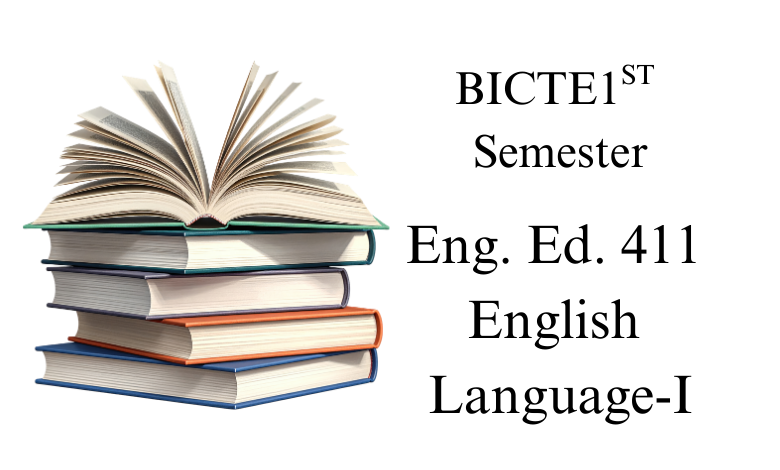
General English I – Course Overview for B.Ed Students
Course Title: General English I
Level: B.Ed (Bachelor of Education)
Semester: First
Credit Hours: 3
Teaching Hours: 48
Nature of Course: Theoretical
Course Description
General English I is a foundational course designed to improve students’ proficiency in English language skills required for academic and professional communication. The course focuses on four major components: grammar, vocabulary, reading, and writing. Through these areas, students learn how to construct grammatically correct sentences, understand academic vocabulary used in different disciplines, interpret written texts, and develop effective writing skills. The course includes carefully selected reading materials related to contemporary and academic topics to help students improve comprehension and critical thinking. In addition, students practice different types of writing that are useful for both academic and everyday communication.
General Objectives
The main objective of this course is to help students develop a strong command of English language skills. It aims to enable students to use grammatically correct English in spoken and written communication. The course also expands students’ knowledge of general and academic vocabulary so they can understand texts from various academic fields. Another important goal is to improve students’ ability to read and interpret different types of written materials. Furthermore, the course helps students learn how to write clearly and effectively on topics related to academic and general interests.
Unit I: Grammar
The grammar section introduces the fundamental structures of the English language. Students learn about different types of tenses and how they are used to express time in sentences. The unit also covers modal verbs, which are used to express ability, possibility, permission, and obligation. In addition, students study question forms, verb structures, determiners, and prepositions to improve sentence accuracy. The unit further explains the correct use of adjectives and adverbs, passive voice, and conditional sentences. Word formation is also included to help students create new words and construct meaningful sentences.
Unit II: Vocabulary
The vocabulary unit focuses on developing academic vocabulary that students commonly encounter in educational and professional contexts. Students learn how to identify and use academic words in different types of discourse. The unit also teaches common word combinations and expressions that improve language fluency. Vocabulary related to academic institutions and educational environments is introduced to help students communicate effectively in academic settings. In addition, students learn how to express opinions, ideas, and arguments clearly using appropriate vocabulary.
Unit III: Reading
The reading component helps students develop skills necessary for understanding and analyzing written texts. Students practice identifying general ideas and locating specific information within passages. The unit includes activities such as determining co-references, matching related information, and understanding written instructions. Students also learn techniques such as scanning to find specific details quickly and skimming to understand the main idea of a text. Furthermore, they practice drawing inferences, interpreting implied meanings, assessing opinions and attitudes, and solving problems related to reading comprehension.
Unit IV: Writing
The writing unit focuses on improving students’ ability to produce clear and organized written texts. Students learn how to rewrite sentences through rephrasing and paraphrasing while maintaining the original meaning. They practice organizing ideas logically and maintaining coherence and cohesion in writing. The unit also covers practical writing tasks such as composing summaries, personal letters, official letters, business letters, and job application letters. Students are taught how to prepare a curriculum vitae (CV) and write reports about events and news. In addition, they practice writing different types of essays, including descriptive, narrative, expository, and argumentative essays.
Instructional Techniques
The course is delivered using a variety of instructional techniques to promote active learning. Teachers may use lectures, discussions, explanations, demonstrations, quizzes, and student presentations to explain concepts and encourage participation. In addition to these general methods, specific activities such as small group discussions, pair work, individual practice, and mini-projects are used to enhance learning. Students may also observe English language classes and share their observations through presentations to develop practical understanding of language teaching and learning.
Evaluation System
Student performance in this course is evaluated through both internal and external assessments. Internal evaluation carries 40 percent of the total marks and is conducted by the course teacher. It includes attendance, participation in learning activities, and several assignments or assessments during the semester. The remaining 60 percent of the marks are based on the final examination conducted by the Examination Division of the Faculty of Education. The final exam includes objective questions, short answer questions, and long answer questions to assess students’ overall understanding of the course.
Recommended Books and References
Students are encouraged to consult recommended textbooks to support their learning. These include New Generation English edited by J. R. Awasthi, G. R. Bhattarai, and T. R. Khaniya for reading and writing units, Academic Vocabulary in Use by Michael McCarthy and Felicity O’Dell for vocabulary development, and Active Grammar Level 2 by Mark Lloyd and Jeremy Day for grammar practice. Additionally, the Oxford Advanced Learner’s Dictionary by A. S. Hornby is recommended as a useful reference for vocabulary and language usage.