– O. Henry
Brief plot
- Despite her impoverished status, Della Young is determined to give her husband a Christmas gift.
- Della Young decides to sell her beautiful hair to buy a watch fob for her husband’s beloved watch.
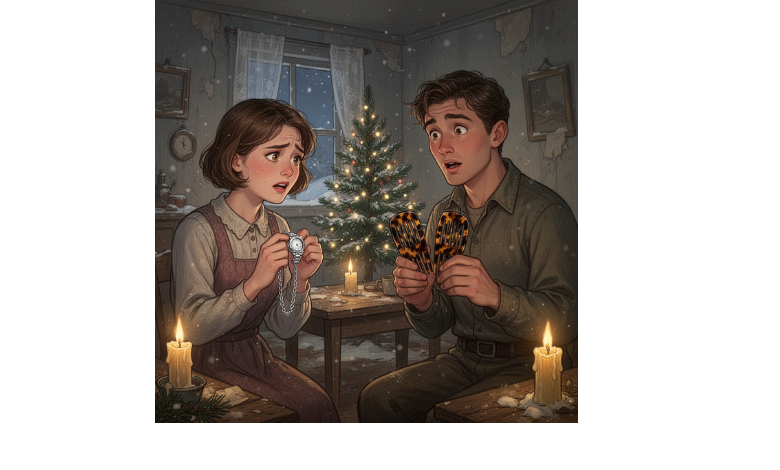
- When Jim comes home, he is saddened and surprised to see Della’s beautiful hair missing. He offers her his gift: bejeweled combs that she no longer needs.
- Della offers her gift to Jim. He looks at her and admits that he has sold his watch to buy her the combs.
- The two are overcome with love as they realize they have sacrificed their most prized possessions for one another.
Summary
The Gift of the Magi is a well-known short story by American short story writer O. Henry, the pen name of William Sydney Porter.
Della Young is a devoted young married woman. Christmas Eve finds her in possession of a meager one dollar and eighty-seven cents, the sum total of her savings (a) , with which she wants to buy a gift for her husband, Jim. A recent cut in the family income, from an ample thirty dollars a week to a stingy twenty dollars a week, has turned Della’s frugality into saving. Although she lives in an eight-dollar-a-week flat and her general surroundings, even by the greatest stretch of the imagination, do not meet the standards of genteel poverty, Della determines that she cannot live through Christmas without giving Jim a reminder of the season.
Distraught, she clutches the one dollar and eighty-seven cents in her hand as she moves discontentedly about her tiny home. Suddenly, catching a glance of herself in the cheap glass mirror in happiness, she lets down her long, beautiful hair falling in caressing folds to below her knees. After a moment, she puts on her old hat and jacket and leaves the flat.
Della’s quick steps take her to the shop of Madame Sofronie, an establishment that trades in hair goods of all kinds. Entering quickly, she offers to sell her hair. Madame Sofronie surveys the luxuriant tresses, slices them off, and hands Della twenty dollars. For the next two hours, Della feels herself in paradise that she can buy anything she wants. She decides on a watch fob for Jim’s beautiful old watch. If there are two treasures (e) in the world of which James and Della Dillingham Young are proud, they are her hair and Jim’s revered gold watch, handed down to him by his grandfather.
She finally sees exactly what she wants, a platinum watch fob that costs twenty-one dollars. She excitedly anticipates Jim’s reaction when he sees a proper chain for his watch. Until now, he has been using an old leather strap.
Arriving back at the flat, breathless but triumphant, she stares at herself anxiously in the mirror, hoping that her husband will still love her. As is her usual custom, she prepares dinner for the always punctual Jim and sits down to await his arrival. The precious gift is tightly clutched in her hand. She mutters to God so that Jim will think she is still pretty.
At precisely seven o’clock, she hears Jim’s familiar step on the stairs, his key in the door. He is a careworn young man, only twenty-two and already burdened with many responsibilities. He opens the door, sees Della; neither sorrow nor surprise. His face is melancholic. Even though Della rushes to assure him that her hair grows fast and that she will soon be back to normal, Jim cannot seem to be persuaded that her beautiful hair is really gone. Della implores him to understand that she simply could not have lived through Christmas without buying him a gift, as well as the seasons, to be happy.
In the excitement he has forgotten to give her gift, and now he offers her a paper-wrapped package. Tearing at it eagerly, Della finds a set of combs, tortoise shell, bejeweled combs that she has so often admired in a shop on Broadway, combs whose color combines perfectly with her own vanished tresses. Her immense joy turns to tears but quickly returns when she remembers just how fast her hair grows.
Jim has not yet seen his beautiful present. She holds it and insists on attaching it to Jim’s watch. Jim looks at her with infinite love and patience and suggests that they both put away their presents—for a while. Jim has sold his watch in order to buy the combs for Della even as she has sold her hair to buy the watch chain for Jim.
Like the Magi, those wise men, who invented the tradition of Christmas giving, both Della and Jim have unwisely sacrificed the greatest treasures of their house for each other. However, of all those who give gifts, these two are inevitably the wisest.
The story ends with a comparison of Jim and Della’s gifts to the gifts that the Magi, or three wise men (d), gave to Baby Jesus in the manger in the biblical story of Christmas. The narrator concludes that Jim and Della are far wiser than the Magi because their gifts are gifts of love, and those who give out of love and self-sacrifice are truly wise because they know the value of self-giving love.
The Gift of the Magi is a classic example of irony in literature. Irony is a literary technique in which an expectation of what is supposed to occur differs greatly from the actual outcome. In this case, Jim and Della sacrifice their most treasured possessions so that the other can fully enjoy his or her gift. Jim sells his watch to buy Della’s combs, expecting her to be able to use them. Della sells her hair to buy Jim a chain for his watch. Neither expects the other to have made that sacrifice.