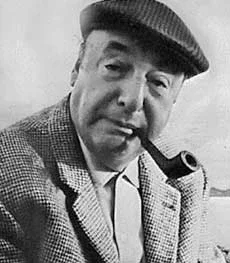
Pablo Neruda
Brief paraphrase
In lines 1-34, the opening lines of the poem describe summer time, how the tomatoes have just been harvested ( l6lkPsf) that the tomato has its own “radiance, a goodly majesty.” Therefore, it’s too bad we must assassinate ( xTof ug'{) it. The red flesh of the tomato looks frightening to cut into.
In lines 35-84: The tomato beds with the blond onion in the salads of Chile, along with olive oil, pimento (chilly), salt, and parsley (wlgofF). The potatoes and the roasts are beating down the door saying: c’mon salad, its Showtime! Tomatoes are the star of the earth, without bones, without husks (af]qmf), scales or thorns.
Brief summary
The cultivation of tomato has turned out to be fruitful and thus the streets are full with vegetable vendors selling tomato and the tomato juice. Then it’s December afternoon where now tomatoes are being used for cooking the dishes in the kitchen where it is sliced and added with onions, olives, potatoes with pepper and salt. Then the tomato dishes are being served at the various occasions like wedding day. Then tomato is shown as a perfect fruit which showers only goodness to others.
Summary
The street filled with tomatoes, midday, summer, light is halved like a tomato; its juice runs through the streets. In December, the tomato invades (xdnf u/]/ lhTg’) the kitchen, it enters at lunchtime, takes its ease on countertops, among glasses, butter dishes, blue saltcellars. It sheds its own light, benign majesty.
Unfortunately, we must murder it. The knife sinks into living flesh, red viscera a cool sun, profound, inexhaustible, populates the salads of Chile happily. It is wed to the clear onion, and to celebrate the union we pour oil, essential child of the olive, onto its halved hemispheres. Pepper adds its fragrance, salt, its magnetism; it is the wedding of the day. Parsley hoists its flag, potatoes bubble vigorously, the aroma of the roast knocks at the door. It’s time! Come on! And, on the table, at the midpoint of summer, the tomato, star of earth, recurrent and fertile star, displays its convolutions. Its canals, its remarkable amplitude and abundance, no pit, no husk, no leaves or thorns, the tomato offers its gift of fiery color and cool completeness.
Interpretation
This ode (;+af]wL sljtf) has several interpretations. It has a conflict between man and nature, man and man, man and woman etc.
The title is a dedication to the underappreciated but beautiful things throughout life. The theme of this poem (c) is that you must learn to embrace the usual things in life that are often seen as dull, and find the beauty within them. “Summer- light is halved like a tomato” is a simile (cn+sf/, b’Oj6f lrhnfO{ bfFHg] kf/f) comparing the time of day to a tomato half, meaning that it is noon. “Tomato invades kitchen” is a personification (lglh{j a:t’nfO{ AolQm dfg]/ k|:t’t ug]{ ;flxlTos k|a[lQ). A tomato cannot physically invade and seize a kitchen; it is meant to show just how abundant ( klutf]) the tomatoes are throughout the kitchen. “It sheds its own light, benign majesty” is a metaphor comparing the beauty the writer sees in the tomato to a wonderful light. He is saying that the tomato is brilliant and gorgeous (zfgbf/); it stands out when he looks at it. “We must murder it” is a hyperbole (hudufpg] kfg'{), exaggerating how we cut up the tomato. “It is wed to the clear onion” is a personification that shows how well the taste of tomatoes and onions complement each other.
This poem is about the conflict (e). The words like “invaded”, “populates the salads of Chile” suggest that the poet is saying about the tomatoes of Chile. Historically tomatoes were at first cultivated at the Peru, Chile and Ecuador regions by the Aztecs. Then only in mid 16th century the Spanish colonizers (;fd|fHojfbLx?) who sailed to Chile and who in turn played a major role in spreading the tomato to European region. Then we all know that the colonizers came for spices, pepper, salt, manganese (l;;f), copper and iron. So, Neruda in this poem gives us the image of tomato, olive, pepper, salt, manganese, potato which were the main objects of the Spanish colonizers.
Now if we read this poem in the light of post colonialism (csf{sf] clwsf/ vf];]/ ;fd|fHo rnfpg’), it gives us a different interpretation where tomatoes is Chile or Chileans who are known for their hospitality; as to benign majesty. The phrases like “two halved tomatoes”(two brothers of royal Inca dynasty who were the native rulers of Chile), “..The knife must sink into its living flesh” suggest the Inca civil war (1,11,000 indigenous (cflbjf;Lx?) people got killed in this war) and the natives being forcibly colonized.) Then the line “..it is wed to the clear onion” suggest that the natives were colonized and civilized by the Spanish. Then the final lines “..no leaves no thorns, the tomato offers it’s gift of fiery colour and cool completeness” gives us the image that the product of Chile is being used by the Spanish where the Chileans aren’t rebelling and have accepted the colonizers.
Marxists literary scholars or practitioners to explain metaphysical or social concepts make use of the common material worldly objects. Similarly Neruda through the common fruit i.e. tomato which was originally cultivated in Chile and Ecuador part and then which was introduced to the world by Spain describes the act of Chileans being colonized by the Spaniards.
Then this poem can also be interpreted by an angle of sex as the tomatoes are frequently associated or symbolized to women. Then the poem is about women who are known for her hospitality and women being a perfect-being as they are known for fertility. Then the poet has glorified (p/fn]sf], dxTj lbPsf]) women who are married to men (tomatoes are wed to onions) and who are the most noble beings (no leaves and thrones).