1. Faculty of Education (FOE)
The Faculty of Education (FOE) is a premier institution for teacher education in Nepal. Established as the College of Education in 1956, it predated the founding of Tribhuvan University in 1959. Since then, FOE has implemented both pre-service and in-service teacher education programs through its constituent and affiliated campuses across the country.
FOE is the largest faculty under Tribhuvan University in terms of student enrollment and the number of campuses. With 26 constituent campuses and 560 affiliated campuses nationwide, it operates the country’s largest network for teacher training. FOE contributes to national development by supplying qualified human resources for schools and the broader educational sector. Its programs cover a wide range of subjects, including social studies, science, and information and communication technology (ICT) education.
Currently, FOE offers programs at the undergraduate and postgraduate levels, including Bachelor of Education (B.Ed.), Master of Education (M.Ed.), Master of Philosophy (M.Phil.), and Doctor of Philosophy (PhD) in Education. B.Ed. and M.Ed. programs integrate academic content with professional courses.
2. FOE’s Vision, Mission, and Goals
Vision:
FOE envisions promoting quality education nationwide by preparing highly qualified teachers.
Mission:
FOE aims to lead teacher education and professional development in Nepal, establishing itself as a center of excellence for teacher training, educational research, and innovation.
Goals:
Produce trained teachers, teacher educators, and educational researchers.
Develop educational planners, curriculum designers, and human resources needed for the national education sector.
Equip graduates with knowledge, skills, and pedagogical expertise to function effectively in schools and educational institutions.
3. Bachelor of Education (B.Ed.) Program
Tribhuvan University and FOE have continuously updated the B.Ed. program to meet national educational needs. Initially, the program was a two-year degree combining subject-specific courses (Nepali, English, Science, Mathematics, Health & Physical Education, Social Studies) with professional pedagogical training, including teaching practice.
In 1996, the program expanded to three years to address concerns about graduates’ content knowledge. Since 2016, FOE has offered a four-year B.Ed. with dual specialization, combining theoretical courses in various subjects with core professional courses and teaching practicum. A specialized ICT-focused B.Ed. program was piloted in select campuses and later evolved into the Bachelor of Information and Communication Technology Education (BICTE) program in 2021.
4. Bachelor of Information and Communication Technology Education (BICTE) Program
Introduced in 2021, the BICTE program is an eight-semester (four-year) undergraduate degree offered across FOE’s constituent and affiliated campuses. The program equips students with expertise in:
ICT hardware concepts and programming
Data structures and management information systems
Computer graphics and web programming
Software development and artificial intelligence
BICTE integrates ICT knowledge with pedagogical training to prepare students as ICT teachers capable of providing innovative solutions for digital education.
5. Goals and Objectives of BICTE
Goal:
Develop socially responsive, creative, and results-oriented ICT professionals for the education sector.
Objectives:
Prepare competent ICT teachers and instructors for schools and educational institutions.
Train IT professionals skilled in computational techniques and problem-solving in educational contexts.
Enable students to pursue postgraduate studies in ICT nationally and internationally.
6. Admission Requirements
Candidates must:
Complete a 12-year schooling program (Grade 12) or its equivalent from a Tribhuvan University-recognized institution.
Achieve at least a “C” grade in each subject (CGPA ≥ 2.0) or secure a second division in 10+2/PCL or equivalent programs.
Fulfill all application procedures.
Admission Process:
Written Test (CEAT): Includes ICT skills (40%), mathematics (25%), English (15%), and educational general knowledge (20%). Minimum passing score: 40%.
Interview: Shortlisted candidates are interviewed based on CEAT performance. Final selection is campus-specific.
7. Instructional Techniques
BICTE uses a mix of teaching approaches, including lectures, group discussions, demonstrations, guest lectures, field visits, seminars, case studies, and problem-solving. Digital pedagogy and technology integration are central to the teaching-learning process.
8. Teaching Hours
Each semester lasts five months.
One credit hour of theoretical courses equals 16 hours; practical or combined courses range from 32–48 hours per credit.
Most courses carry 3 credit hours.
9. Teaching Practicum
In the final semester, students complete a seven-week practicum in educational institutions. Evaluation is based on:
Organization’s confidential report
Individual project report
Presentation of the report
The practicum carries 3 credit hours, and students must achieve at least a “C” grade.
10. Examination and Grading System
Semester-based system: 8 semesters in total.
Internal evaluation: 40%; external semester exam: 60%.
Minimum internal grade to appear in exams: B- (GPA 2.70).
Minimum passing grade: B- (CGPA 2.70).
Grading Table:
| Letter | GP | SGPA/CGPA | % Range | Remarks |
|---|---|---|---|---|
| A | 4.0 | 4.0 | 90+ | Distinction |
| A- | 3.7 | 3.70–3.99 | 80–89.9 | First Division |
| B+ | 3.3 | 3.30–3.69 | 70–79.9 | First Division |
| B | 3.0 | 3.00–3.29 | 60–69.9 | Second Division |
| B- | 2.7 | 2.70–2.99 | 50–59.9 | Third Division |
| F | 0 | <2.70 | <50 | Fail |
11. Make-up/Retake Exams
Conducted according to Semester Guideline 2074, Section 4(10).
12. Attendance
Students must attend at least 80% of all lectures, practicals, seminars, field trips, and presentations to qualify for semester exams.
13. Credit Transfers and Withdrawal
Credits earned from similar programs at Tribhuvan University-recognized institutions can be transferred.
Students may withdraw mid-program and receive a certificate for credits earned.
14. Graduation Requirements
Complete 132 credit hours over eight semesters.
Achieve a minimum aggregate CGPA of 2.70.
Complete all requirements within seven years of registration.
15. Curricular Structure
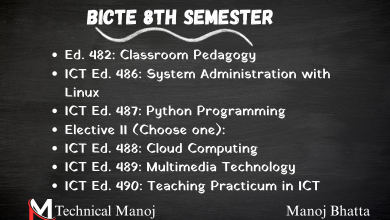
The BICTE program spans 4 years and 8 semesters, totaling 132 credit hours, combining theoretical, practical, and professional pedagogical courses.
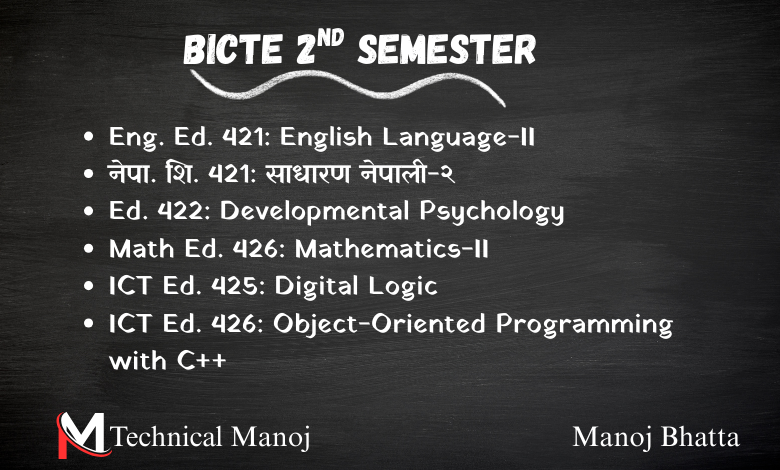
Second Semester (6 × 3 = 18 Credits)
| S.N. | Course Title |
|---|---|
| 1 | Eng. Ed. 421: English Language-II |
| 2 | नेपा. शि. 421: साधारण नेपाली-२ |
| 3 | Ed. 422: Developmental Psychology |
| 4 | Math Ed. 426: Mathematics-II |
| 5 | ICT Ed. 425: Digital Logic |
| 6 | ICT Ed. 426: Object-Oriented Programming with C++ |