Anonymous
Folk literature records the beliefs of people as they appear in popular custom, tradition, magic and ritual. The central figure in Indian folk-tales is a hero or heroine who is usually poor and destitute at the start but who, after a series of adventures attains his/her goal-viz. marriage to a prince or princess-and lives happily ever after. The theme of the story is that one who is good at heart and has faith, patience and ingenuity gets a good fortune sooner or later.
Summary
‘The Dancing Goats’, narrated by Baba Trinco, tells the tale of a poor and hard working youth who succeeded in marrying the beautiful daughter of the landowner. His success owed partly to the magic of the flute and a stroke of luck. Mainly it was on account of his goodness of heart, faith, patience. He was lucky enough to come by three dancing goats. They brought comfort to his widowed mother and a pretty rich wife for himself. Sindhu lived with his mother in a small hut. He had a small plot of grazing land and two cows. There was severe drought for a year and his mother told him to go to market to sell his cows because of the shortage of fodder.
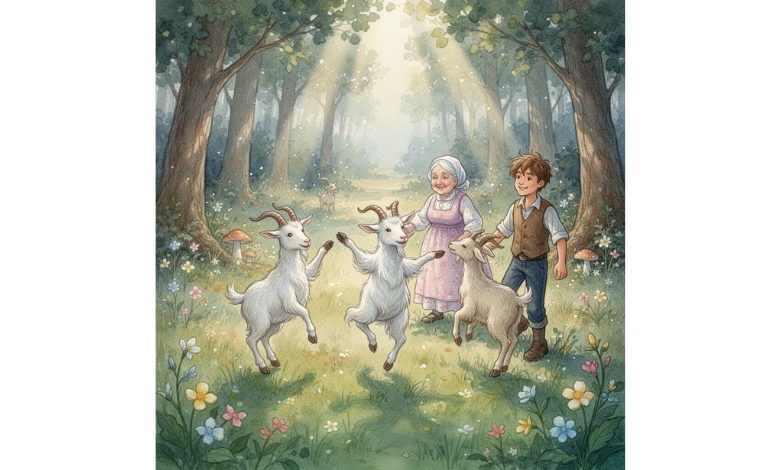
On his way to town he met an old woman who was going to the market to sell her goats. They rested under a tree feeding their pets; Sindhu was upset for selling the cows to the butcher. The woman offered to exchange her goats with Sindhu’s cows, but he denied that he did not have any grains for goats. She convinced him that the goats will bring fortune to him some day. Then she drew a flute from her basket and began to play on it and the three goats began to dance to its tune. Sindhu was greatly amused from the goats; which were brought from the Himalayas. He believed what the old woman said about them, and thought the goats might not bring fortune, but he will certainly earn a few pennies by entertaining the village-folk and he accepted the offer, she gave him flute and goats and took his cows.
When he arrived home with the goats in delight, his mother was unhappy at the bargain made by him. She felt he had been cheated by the market folks. But Sindhu played flute and the goats started dancing. Sindhu was satisfied with the bargain he had made and believed in what the old woman had said to him. He had faith on the old woman.
Sindhu’s landlord was in the village and his beautiful daughter heard of three dancing goats and she told her father to invite the peasant with his goats for entertainment. Her father summoned him to their house to see the dancing goats. Sindhu played on the flute and the goats danced merrily. The landlord’s daughter offered to buy one of the goats and asked him the price. Sindhu told her that the goat cannot be purchased, and she should visit his widowed mother and give a barrel of foodstuff in the exchange of one of his goats. She accepted his offer, visited the hut with a barrel of food stuff; where she was warmly welcomed by Sindhu’s mother and got the goat. But the goat didn’t dance in the landlord’s house. Sindhu was again called in the landlord’s house and the girl told Sindhu that village priest had told her that the goat will not dance without a companion and she wanted Sindhu to sell his another goat too. Sindhu agreed in exchange for the gold ring on her finger and barrel of foodstuffs this time. The girl accepted the offer and got another goat.
But, again after few days Sindhu was called again in the landlord’s house because both goats did not dance even in the music and she wanted the third on which Sindhu had. She said that the priest told her to have another company to dance. Then Sindhu played the flute and the goats started dancing merrily. The girl cried that it was the power of the magical flute that made the goats dance and asked him to give his flute as well as the third goat. He asked two things this time; first to tell the mystery of the three different coloured stones set in the gold ring, and second foodstuff and she agreed. And he gave landlord’s daughter the flute and the third goat, as he would love her by heart but could not express. She got happy having the flute and the goat and told him the secret of the three different coloured stones on her ring that her hair had three colours matching the colour of the ring.
Sindhu wondered what happens when his foodstuff finishes in his house. He could not earn any penny without the help of the goats. But he remembered the old lady’s words that the three goats would bring his luck in his life. He was working in the landowner’s farm and he was happy that he could see her face there.
One day landowner announced his intention of finding a bridegroom for his daughter and declared that whoever could name the three strands of hair hidden among her black silken tresses should have her as his bride. Many young men from different parts of the country came to try their luck but, no one could make the right guess. A young man was coming to tell the truth of the colours and get the girl; he met Sindhu and asked the way to the landlord’s house. Sindhu showed the way and said that he knows the truth of the colour but he cannot say without going in front of the girl in new dress. Sindhu got an opportunity to enter the landlord’s house as the servant of a rich suitor. The young boy managed it and went to the house where many suitors were trying to find the mystery of the colour. They did not recognize Sindhu in the ne livery with a turban and told the secrecy of the colour tresses; white of diamond colour, dark red of ruby and bright green emerald. The landlord was happy from the answer and he disguised as peasant as poor Sindhu. The young man denied it but landlord asked his daughter how it happened. Sindhu also showed the ring of the three coloured stones that the lady had given him in exchange for his second goat. In this way Sindhu got landlord’s daughter for his bride. Sindhu in the end said that it was the triumph of faith, love and patience. The couple lived happily ever after.