Unit 4: Process of Curriculum Development (5)
4.1 Concept of Curriculum Development.
4.2 Steps of Curriculum Development.
4.3 School level Curriculum Development
Process in Nepal.
Process of Curriculum Development
Curriculum is a systemic planning for conducting teaching learning process. It represents the interests, need, and necessities of the learners. Culture, society social needs, national needs become the basis for curriculum. Educational philosophy and sociological structure of pattern are the sources of the foundation for curriculum construction. Moreover, the explosions of knowledge create a complexity so far as the curriculum is concerned. Curriculum construction is not a single person’s tax. The unified coordination among teachers, students, parents, social and political activists, educationists, related subject specialists etc. can make the curriculum relevant and effective.
Concept of curriculum development
Curriculum development is focused on the improvement and innovation of education. During this process, which may take many years – especially where generic (basic) curriculum development is concerned, which extends beyond (further than) a specific local context – desires and ideals are
incorporated (included) in a cyclic process of design, implementation and evaluation to achieve concrete results in practice. In these models five core activities are distinguished,
DESIGN
IMPLEMENTATION
EVALUATION
ANALYSIS
DEVELOPMENT
Core activities in curriculum development
In a cyclic process, analysis, design, development, implementation, and evaluation take place interactively. Curriculum development often starts with an analysis of the existing setting and the formulation of intentions for the proposed change or innovation. Important activities in this phase include a problem analysis, a context analysis, a needs analysis, and an analysis of the knowledge base. Based on these activities, first design guidelines are drawn up. The design requirements are carefully developed, tested and refined into a relevant and usable product. Evaluation plays an important role in this process, as can be seen from its central position in the model. Evaluation activities cast light on the users’ wishes and possibilities in their practical context and reveal the best way to attune (adjust) the product to the
practical setting. When the product has sufficient relevance, consistency and practical usability, the impact of the product can be investigated. Whereas the primary emphasis lies on generating suggestions for product improvement (formative evaluation), during later phases, this emphasis is shifted towards the evaluation of effectiveness of (summative evaluation).
4.2 Steps of Curriculum Development
By following our six steps for curriculum development, you’ll be sure your students can follow the course you plot for them.
- Evaluate Effectiveness.
- Determine Your Target Audience.
- Develop Goals and Objectives.
- Choose Your Instructional Strategy.
- Consider Logistics.
- Develop Assessments.
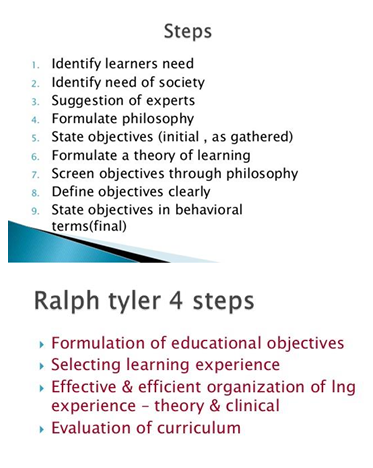
Taba’s seven steps of curriculum development:
- Diagnosis of needs
- Formulation of objectives
- Selection of content
- Organization of content
- Selection of learning experience
- Organization of learning experiences
- Evaluation , evaluation process and means determination
In BED level curriculum
- Need identification
- Determination of aims goals and objectives
- Selection and organization of content
- Selection and organization of learning experiences
- Evaluation of curriculum
For mor details: Steps of curriculum development | PPTX
School level curriculum development process in Nepal.
Undoubtedly curriculum is a base of education. It is an essential aspect of education. Curriculum gives existence of education and without education curriculum does not exist, too. They are interrelated to each other and so are between human being and education. The development of human being and the development of education seems to be taken place simultaneously. That is why development of human development of education and development of curriculum go hand in hand by helping one another.
However no clear demarcation line can be drawn from when the curriculum started to exist, thought education is found to be changing to meet the needs and aspiration of individual and society. Throughout the western as well as eastern history of education, it is found to be used as a means of getting salvation however no written curriculum was existed in the very past. At that time education remained within the confine of the religious doctrine. In other words, religious institutions provided education which was dedicated to the religious principles to promote religious impact. Religious scriptures like Bible and Korean were started teaching Christian and Muslims respectively and Geeta, Chandi, Veda etc. were thought in Gurukul educational system so far as Hindu religion is concerned. At that time the main objectives of education were to preserve, develop, promote and to transfer culture and religion to the successive generation by evoking and individual to have self actualization. From the beginning of the age of science and technology, a conflict can be seen between materialism and spiritualism. Because of the explosion of scientific knowledge and technical materials, education starts having large impact on religion. How, education cannot be an escape from the influence of the development of science and technology. That is why curriculum takes different pattern in different period of time for the sake of serving needs of individual and the society. However the history of curriculum development of Nepal is not so long, though in some extent the development of education and curriculum seem to follow the certain pattern as the change of time.
That is why the development of education and curriculum of Nepal can be
classified into three different parts as follows:
•Ancient age (Before 1903 BS)
•Medieval age
•Modern Age
curriculum development centre (CDC) is organize under Ministry of Education to develop the school level curriculum in Nepal. Generally Ministry of Education performs the leadership role so far as the school
curriculum of Nepal is concerned. It is the highest leadership organ. But, so far as the curriculum development is concerned, the curriculum development centre (CDC) holds all responsibility under the leadership of Ministry of Education.
Curriculum Development centre (CDC) studies the contemporary society, interests and needs of individuals, explosion of knowledge and makes the pattern of curriculum, Then such curriculum is implemented after accepting by National curriculum council (NCC). To develop curriculum and textbooks, different branches are organized to develop the curriculum of primary and secondary level and under this branches differet units are there to coordinate regarding the different tasks of curriculum. To make the
proposal of curriculum, a subject committee is organized by including concerned subject teachers and subject specialists. Technical committee can reform the proposal prepared by subject committee. Such subject wise technical committee can be organized by national curriculum council. And, National curriculum council approves the curriculum then only such curriculum goes into the implementation phase.
Process of school living curriculum development
- Suggestions collection
Cubiculum development centre organizes a curriculum work committee including specialists which consult with parents, teacher students, politicians, social workers, educationists etc. And, it prepares a proposal by collecting the necessary subject matters including the suggestions. - Selection of specific objectives
On the basis of collected suggestions, the grade wise specific objectives are selected. Concerned subject specialists and subject committee select the intended teaching achievements. - Curriculum proposal committee
Curriculum development centre (CDC) organizes the different subject committees in every subject. And ,every subject committee prepares the proposal of curriculum in its concerned subject. It is the responsibility of subject committee to prepare the proposal of the curriculum. Sometimes it can organize a different committee or subcommittee to prepare proposal. - Discussion in subject committee
Concerned subject committee discusses upon the proposal made by curriculum proposal committee. Since subject committee is an organized body of subject specialist, educationists, teachers, observers, trainers and different scholars, it gives significant suggestions regarding proposal. - Reformation in terms of the suggestions
The proposal of the curriculum is again sent to curriculum proposal committee with the suggestions. Such proposal is reformed in terms of the suggestions and submitted to curriculum development centre or subject committee. - Present to national curriculum council
National curriculum council can make a technical committee and such technical committee observes the proposal of curriculum. It studies, discusses in depth and can return the proposal to the committee again with suggestions. It evaluates the standard of the curriculum. Without acceptance of National curriculum council, the curriculum cannot be implemented. - Curriculum implementation
After approving the curriculum by national curriculum council, it goes to implementation phase. Curriculum Development centre implements it by producing the textbooks and managing the necessary materials. The different sectors which play significant role to the construction
and development of curriculum are as follows:
- Ministry of Education
- National Curriculum Council (NCC)
- Curriculum Development Centre (CDC)
- Basic and primary Education Project (BPEP)
- national Centre for Educational Development (NCED)
more details: Shiksha 2063 Paush