Unit III: Curricular Components (17)
2.3 Aims, goals and objectives
- Concepts and relationship
- Types of objectives: general and specific
- classification of objectives: cognitive,
affective and psychomotor
2.4 Content: selection and organization
2.5 Teaching-learning experiences - Criteria of selecting and organizing
Learning Experiences - Teacher initiated and learner initiated
experiences
2.6 Evaluation /assessment of student learning
Curricular Components
The multiple aspects, which are accumulated in curriculum, are called components of curriculum. Since curriculum is a directive principle which is made for conducting teaching process, it embodies multiple aspects as what to teach, why to teach, how to teach and whether the learners succeed to get target or not etc. In other word the whole aspect that a curriculum possesses are its elements or the aspects which are necessary for curriculum is regarded as elements of curriculum.
Unless the components of curriculum are analyzed or clarified, the curriculum constructor and practitioner remain confused. According to R.W. Tyler, a good curriculum is expected to possess following components:
- General and specific objectives (objectives)
- Content
- Teaching learning strategies (strategies)
- Evaluation
3.1 Aims, goals and objectives
Every activity has its own goal or target which aims at accomplishing certain purposes. Since curriculum is a complete planning for conducting teaching-learning process, it determinates the subject matter, teaching methods and evaluation procedures to achieve the certain achievement in every class. Every curriculum tries to assimilate some behavioral change in learners. the curriculum determines the knowledge, skill, capacity and concept which are expected to be developed in the learners.
Psychologist Hilda Taba asserts that education aims to equip that aspects to the learner what he/ she lacks. It makes him/ her master as regards his/ her necessity and makes him/ her develop understanding power, insights and appreciation. The main aim of education is to change individual in some way either addition knowledge or enabling them to perform in certain way. These expected or desired outcomes are usually regarded as the educational objectives.
Every curriculum has some objective which aims at fulfilling the need of concerned sectors. It tries to meet the necessities, needs and aspirations of the society interest of an individual etc. After analyzing all of those, it determines to develop certain skill, knowledge and concept to the learners of certain age, grade and level. Such expected change in certain group is the objective of curriculum. Objectives are varied in terms of the grade and level. In other words, the objectives of curriculum in one class differ from other classes. Therefore, objectives of curriculum can be determined by analyzing the age variation, interest, capacity, skill and knowledge of the learners. In fact, after the end of certain period of the teaching learning process, the behavioral change, which period of the teaching learning process, the behavioral change, which society expects from the student and referred by the curriculum is considered as the objectives curriculum.
Some definition of objectives
Hilda Taba
“The chief activity of education is to change individuals in some way: to add to the knowledge they process, to enable them to perform which skills otherwise they would not perform, to develop certain understanding, insight and appreciations. The statements of these expected or desired outcomes are called either educational aims or educational objectives.”
Goodland and Richter
“A remote end for the guidance of educational activity is called objectives.”
Saylor and Alexander
“Objectives that the specific overt changes in the students’ behavior that are expected to result from participation in a unit of learning activities. Obviously they develop more explicitly the general goals and their respective sub-goals for the purpose of planning instruction.”
Teacher guide
“Objectives are the statements of expected or desired outcomes or the statements of desired change in student behavior.”
In fact, curriculum embodies two kinds of objectives- general objectives and specific objectives.
• Types of objectives: general and specific General objectives:
The general objectives are such types of objective which is expected to be achieved at the end of the class in average. It is the common objective which is expected to be fulfilled as a whole. It is different with the specific objective because it does not specify the particular knowledge of skill rather if determines the large common elements. For example, for the construction of “social studies” of class ten, such objective can be general objective: After having passed class ten, the students can show their respect toward social norms and values and can behave as well. This is wide objective which does not consider specific purpose. It does not say what kind of social norms and values and behavior the students would possess. However, it is wide and not specific, though it refers the installment of social concept in the students which ultimately helps to other activates of that particular subjects.
However, such general objectives can be achieved only when a certain knowledge, skill and capacity are developed in the learners. That is why general objectives are not measureable themselves rather they are measured through the specific objectives. Therefore, curriculum most contain the specific objectives saturated (flooded) with particular knowledge, skill, capacity and concept. Nevertheless, general objectives are common expected purposes desired to accomplish through the teaching learning process.
Specific objectives
Specific objectives are the particular expectation to be fulfilled at the end of the class. Specific objectives aim at developing certain knowledge, skill, concept and capacity that lead a learner to meet the expectation of general objectives at last. for example, if the development of concept to the students regarding social norms and values can be the general objective of social studies of class ten, then every topic of that text has particular objective which ultimately covers the area of social concept. Specific objective refers the certain skill, knowledge, concept and capacity to be developed to the students, in other words, they are such objectives which are particularized and focused much. Every topic might have general as well as specific objectives. But specific objectives are particular, they are measurable, too. Specific objective clearly includes three aspects-what can the learners be able to do at the end of this class? In which situation can they be able to do? And, in what status they can do?
Functions of Specific Objectives
- To decide about the selection of content and learning experience. The specific objectives direct the path in selecting subject matter and the intensity of knowledge for providing the students. Specific objectives help the curriculum to release from the confusion of the heap of knowledge in other words; specific objectives pave the way and helps curriculum to delimit (define) its territory (area). As such content and learning experiences are selected in terms of specific objectives.
- To help to select from wide area of knowledge in the various disciplines which are extremely necessary for some valid achievement.
- To clarify the mental and other powers which need to be developed.
- To provide a common, consistent focus for multifarious activities of curriculum.
- To evaluate the outcomes
Important aspects for constructing specific objectives
The following three things must be paid full attention for constructing
specific objectives:
a) Selection of teaching objectives.
b) Classification of teaching objectives.
c) Specification of teaching objectives.
Selection of teaching objectives.
Objectives can be short term and long term, and it can also be classified
as general objectives and specific or practical objectives. Specific objectives
should be out and out based on the age variation, grades, interest, ability and
potentiality of the learners.
Educationist Benzamin Bloom classified educational objectives as
follows:
i)Cognitive domain
ii)Affective domain
iii)Psychomotor domain
SO far as the teaching objectives are concerned, the following things
should be paid full attention:
i)The ability of students before the teaching.
ii)The ability of student after the teaching
iii)The condition of teaching materials available in the teaching process.
Cognitive Domain
Cognitive domain includes the objectives of knowledge which aim to develop the mental and intellectual capacity of learners. The objectives of cognitive domain are able to enhance the intellectual and mental intelligence as regards the individuals’ interest, needs and necessities. Benjemin Bloom classifies the objectives of cognitive domain hierarchically from simple to complex order as follows:
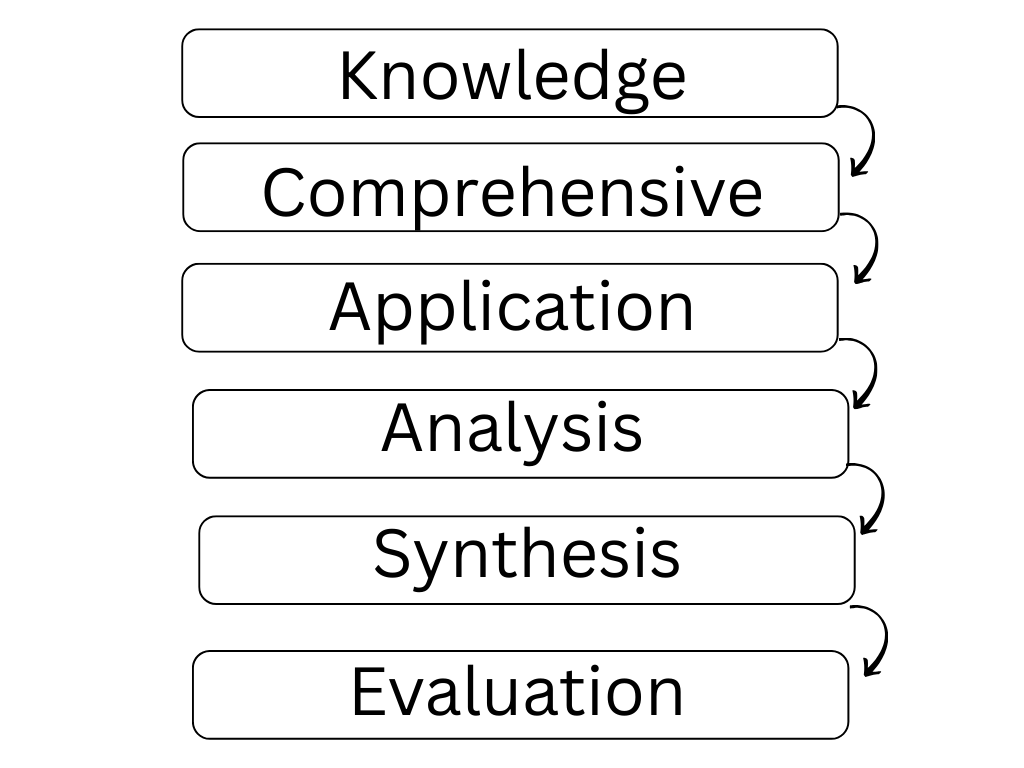
1. Knowledge
“Knowledge” takes the first place in the hierarchy of cognitive domain. It is regarded as the lowest level of understanding. Such objectives expect the learners to reacall and to recognize previous learned things. For instance, to remember, to recall, to recognize, to distinguish etc.”Knowledge” takes the first place in the hierarchy of cognitive domain. It is regarded as the lowest level of understanding. Such objectives expect the learners to reacall and to recognize previous learned things. For instance, to remember, to recall, to recognize, to distinguish etc.
Cognitive domain objectives use the following action verbs:
- to recall
- to write
- to recognize
- to say
- to identify
- to measure
- to distinguish
- to describe
- to define
- to list
- to remember
- to name etc
2. Comprehensive
Comprehension means the ability of the learners to comprehend the taught contents. For examples, to explain learned fact and principles, to summarize the learned thing etc. It is also regarded as the lower level of understanding. In the process of constructing the educational objectives of comprehension, the following action verbs should be used:
- to differentiate
- to translate
- to summarize
- to illustrate
- to predict
- to explain etc.
3. Application
Practice of learned thing in the practical day to day life is called application. Application of different theories, principles, methods, concepts etc. in the activities is regarded as application of cognition. The following verbs are used while constructing educational objectives of cognitive domain:
- to apply
- to generalize
- to transfer
- to organize
- to demonstrate
- to classify
- to relate
- to solve etc.
4.Analysis
To study the content by classifying the organization of content into different parts is considered as analysis. It is higher intellectual level of study. To identify the learned things, to gives reason logically, to clarify the relationship of the facts etc. are some examples of analysis. While making objectives of this level, the following action verbs are used:
- to analyze
- to debate
- to identify
- to distinguish
- to relate
- to compare to select
5. Synthesis
To accumulate or synthesize various learned knowledge, skill and experience in to one is regarded as synthesis. To organize, to separate is called syntheses of knowledge. Different creative works, problem solving planning, researches, dissertations, analysis of the events etc. are example of synthesis. The following action verbs are used while constructing the objectives of this level:
- To research
- To produce
- To plan
- To organize
- To unite
- To conclude
6.Evaluation
To evaluate whether the teaching of content is on the basis of objectives or not is called evaluation. It is the highest level of learning of cognitive domain. The learners are expected to provide their decision in this level. For examples to give decision about content, to criticize or support the facts etc. The following action verbs are used while constructing the objectives of this level:
- To evaluate
- To judge
- To compare
- To criticize
- To support
- To chose
B. Affective Domain
The effects of learning to the intellect, emotion, experience, interest etc. of learners fall under affective domain. In other words, the effect of learning to the learners’ emotional aspects is called learning of affective domain.
Benjamin Bloom classifies the objective of affective domain into five parts. They are as follows:
- Receiving or attending
- Responding
- valuing
- Organization
- Characterization
a. Receiving or attending
Learners’ interest of receiving or attending any stimulus, activity and events is regarded here as receiving or attending. The following action verbs are used while selecting the objectives of this level:
- To receive
- To attend
- To listen
- To differentiate
- To share
- To accept
- To select
b. Responding
The active participation of learners in teaching learning activities is called responding. The learners’ response is the major factor to know wheather they achieve the learning or not. In teaching learning activities only, the positive respond is always expected. In the formation of objectives of this level, the following action verbs are used:
- To present
- To respond
- To recognize
- To practice
- To discuss
- To enjoy To play
c. Valuing
To respond towards some stimulus, events and activities is called valuing. For example, to respond whether it is wrong or right in the classroom teaching. The following action verbs are used while making the objectives of this level:
- To value
- To change
- To assist
- To explain
- To judge
- To prepare
- To deny
- To help
d. Organization
To accumulate different values into one is called organization. Application of all of those learned experiences in practice in an organized way is regarded as organization. The following action verbs are used while selecting the objectives of this level:
- To organize
- Ro relate
- To define
- To generalize
- To compare
- To assimilate
- To adjust
Characterization
To decide about the various knowledge, skill, behavior and activities of learning is called characterization. This level includes individual view, perception and thought. The following action verbs are used while constructing the objectives of this level:
- To characterize
- To review To interpret
- To unite
- To revise
- To command
- To change
- To complete
C. Psychomotor domain:
Psychomotor domain includes knowledge, skill and capacity which are learned by physiological procedure. These activities or behavior are carried out through the involvement of mental senses and physical adjustment. It is also renamed as skill learning because it involves the sense, and is regarded as real learning, too. It involves physical activities on the basis of mental capacities. For instance, cycling, swimming, driving, typing etc.
Psychomotor domain is classified differently by different psychologists. Psychologist Miles and his friends classify it as follows:
- category of Gross Bodily Movement
- category of finer Bodily Movement
- category of Non-verbal Communication Behavior
- category of Speech Behavior
Like Miles and his friends, other psychologists have also contributed on the classification of psychomotor domain. Especially, according to other psychologists, the psychomotor domain can be classified as follows:
- Reflex movement
- Basic fundamental movement
- Perceptual abilities
- Physical abilities
- Skilled movement
- Non-disclosure communication
E.M. Simpson classified the objectives of psychomotor domain as follow:
- Perception
- set of perception
- Guided response
- Mechanism
- Complex overt response
- Adaptation
- origination
1.Perception
To perceive is necessary to learn anything. Perception is the first step of psychomotor skill learning. To perceive anything through the senses to differentiate, to distinguish etc. are some examples of perception. The following action verbs are used in the process of selecting the objectives of this level:
- To distinguish
- To conform
- To differentiates
- To describe
- To explain etc.
2. Set or preparation
To prepare for certain stimulus is called set. It includes mental, physical and emotional preparation. The following action verbs are used while selecting the objectives of this level:
- To start
- To response
- To act
- To start
- To show etc
- Guided responses
To adopt or accept the direction or to perform the activities on the basis of rules and regulation for learning any motor skill is observing the teacher’s performance. For this, learners must follow certain rules and regulation. The following action verbs are used in the objectives of this level:
- To demonstrate
- To orient
- To construct
- To add
- To measure
- To organize
- To combine
Mechanism
Mechanism in learning means to perform the action as a machine does. The repetition and practice of learning leads the learners to perform the action without other direction or guidelines. The following action verbs are used while making the objectives of this learning:
- To apply to organize
- To change
- To construct
- To say
Complex overt response
To perform and apply the learned things as necessary is called complex overt response. It is regarded as an ordinary response of complex task. Driving, clycling, typing, swimming, etc. are some examples of it. The following action verbs are used while selecting the objectives of this level:
- To response
- to apply
- To change
- To attempt
- To exercise
- To practice
- To activate
Adaptation
Application of learned things into the behavioral activates in terms of situation or condition is called adaptation. For instance, to drive cautiously in the bending road, to play musical instrument by observing while other playing etc. The following action verbs are used in the objectives of this level:
- To reconstruct
- To adopt
- To change
- To adjust
Origination
In the process of teaching learning activities, learners may perform their own creativity or novelty that is called origination. For instance, to compose the rhythm of music, to create new styles in fashion, etc. are some examples of it. The following action verbs are used while construction the objectives of this level:
- To create
- To produce
- To construct
- To manage etc.
Content
Content is another important element of curriculum. After the selection objectives, appropriate determination of content provides the necessary learning experience. On the basis of objectives, it is necessary to select relevant content to develop necessary knowledge, skill, capacity and concept in the students in terms of the learners’ necessity, grade, age, interest, capacity etc. Specific objectives lead to appropriate selection of content. And, it is content which leads a learner to have objectives. That is why selection of content does matter a lot in the teaching learning process.
Content contains full responsibility of the development of intellectual capacity, knowledge, skill, ability etc. of an individual. In other words, content is selected to improve behavior in desired way which also evaluates whether the learner gains those behaviors or not. It is an organizational aspect based on potential behavioral pattern of all related sectors of education.
The organizational aspect of teaching and learning, which is constructed as regards the potential theoretical principles and practical aspect of various subjects, is called content. Content helps to enhance the knowledge, skill and experience of a learner. Generally, content means the answer of what is to be taught or learned. Moreover, content is that strong and effective aspect which evaluates the intellectual aspect of the learner. On the basis of certain objectives and achievements, by making the foundation of desired skill, knowledge and concept to be developed in the learner, content includes related subject matters and learning experiences.
Educationist Burner views that the pattern of content is a principle, an organization of list of teaching subject matters, and a discipline determined in terms of the research methodology of subject matters. Such organization of subject matters causes an explosion of knowledge to the student. That is why content holds an important place in curriculum.
Nevertheless, in the process of selection and organization of the content of any formal education, the following criteria must be paid full attention:
Criteria for selection of content
- Criterion of validity
- criterion of significance
- Criterion of interest
- Criterion of learn ability
- Criterion of relevancy
- Criterion of utility
- Criterion of authenticity
- Criterion of democratic value
- Level
- Grade
- Subject
- Learning experience
Criteria for Organization of Content
- Continuity
- Relevancy
- Scope or adequacy
- Sequence
- Integration: Vertical integration
- Horizontal integration
Teaching learning experience
Generally, learning experience means those learned knowledge, skill and concept which the learners learn by different activities. Unless the learners get experiences, they cannot learn. In other words, what they experience means that they learn.
Learners get learning experience not through only one way but various ways like formal education, non formal education, informal education etc. That is why the achievement of the learners through the interaction of others whether it is formal, non formal and informal is regarded as learning experiences.
The methods, procedures, process, techniques and designed plans through which the selected subject matters are accomplished or reached to the learner are called teaching learning strategies. Since teaching learning process follows certain text in classroom, there is close relationship between subject matters and teaching methods. Curriculum needs to mention teacher’s activities, learner’s activities as well as teaching learning activities and process of presenting learning experiences in a systematic organized way. Only then practical and effective teaching learning process can take place. Interrelationship between teacher and learners and opportunity of practice to learners lead to achieve the instructional objectives. Effective organization of teaching learning strategies and learning experiences lead to have integration between scope and sequence of curriculum. The more subject matter is presented effectively, the more skill and knowledge can be accomplished. Appropriate teaching learning methods lead a learner to meet his/ her motive and initiate another motive.
Criteria of selecting and organizing Learning Experiences
A learning experience cannot provide the different learning objectives. Different learning experience are needed to fulfill different learning experience are provided to the learners to achieve the select the pattern of knowledge, skill and concept and as a whole learning experience to provide to the learners to attain the selected objectives.
Interest, needs, individual difference, attitude of the learners, social aspirations and necessities should be paid much attention in the process of selecting learning experience because it is the learning experience which leads a learner to get the objectives. Only the relevant learning experience gives intended objectives to the learners. Practical, need oriented, situational, vocational, activity oriented, Behavioral, creative and technical learning are regarded as the relevant learning experience. All of those contribute to develop the knowledge, concept, skill, capacity and responsibility of learners toward the society. Ultimately such learning experience helps to motivate learners to the learning.
The learning experience should be selected on the basis of following criteria:
a. Providing Opportunity to the learners to practice Expected Behavioral b, Criteria of satisfaction from the Learning Experiences
- Need oriented
- Relevant learning
- Vocational
- Interest
- Ability oriented
- Skill oriented
- Creativity
- Action oriented
c. Criteria of learning experience that brings Several Outcomes
d. Learning Experience: Within the Range of the Objectives of the students
a. Providing Opportunity to the learners to practice Expected Behavioral:
To achieve the goal, purpose or objectives determined by the learning called the achievement of expected behavior. Each and every learning embodies certain goal or objectives. Learning aims at modifying the behavior of learners in desired way in general. The objectives of curriculum direct the learners; behavior or activities. Practice leads the learning to achieve instructional objectives. That is why such learning experiences should be selected in which learners get more opportunities to practice. For example, if the curriculum possesses the objectives of developing the concept of function of a machine, the learners should be provided opportunities to observe and to operate the machine themselves. Or if the curriculum intends to teach the drawing of something, the opportunity of practice of drawing should be provided to the learners. Otherwise expected behavior always remains expected and learning goes in vain.
The learners remember those things much which they have practiced much. Recurring application of learned knowledge, skill and concept become stronger and long lasting.
b. Criteria of satisfaction from the learning experiences
The learning experience, which satisfies the learners, has more probability to the repeated over and over again. The learners do not like to repeat the unpleasant result. That is why learning experiences should be interesting and pleasurable.
Generally, the learning experiences, which are based on the following elements are believed to provide satisfication to the learners:
- Need oriented
The learning experience, which is based on the individual as well as social and national needs and necessities, satisfies learners.
- Relevant learning
Each and every learner wants to learn that the learning which is practical, believable, life oriented, valid and scientific.
- Vocational
To be learning vocational means to address the real needs of individuals. Vocational learning makes the learners self dependent.
- Interest
- Ability oriented
- Skill oriented
- Action oriented
C. Criteria of learning that brings Several outcomes
When single learning experience provides two or more than two results, it is regarded as an effective learning. Such learning helps to develop the multi faced aspects of the learners. Undoubtedly it develops the knowledge and skill of the learners. For example, learners learn to apply the concept of digits of mathematics in their day to day life after they have learned digits in the classroom. So, it is a positive learning.
When learning provides various learning experience, it is necessary to have well-managed planning otherwise learning may give unexpected or negative outcome, too.
d. Learning experience: Within the range of the objectives of the students
The learning abilities and capacities of the learners vary in terms of their age. The learning experiences out and out depend on the abilities and capacities of learners. Therefore, different curricula are made for the learners of different grades or levels.
Learning experience always should be provided on the basis of learners’ capacity by keeping into consideration the individual differences. Otherwise the learning experiences either become too much easy to the learners of the learners cannot keep on learning because the learning become too much tough or difficult to learn.
Organization of learning experiences
Learning experiences are always related among one another. It is the function of curriculum to organize those learning experiences well. The construction of curriculum means the well organization of learning experiences. Until the curriculum organizes the learning experiences, it cannot provide the intended objectives. The curricula, which are applied in formal educational system like school curriculum and college level curriculum are organized well. That is why they can provide intended objectives to the learners systematically. Generally, learning experiences can be organized into two ways:
Vertically integration
Horizontal integration
Vertical integration
The learning of lower grade or level is the base for the upper level. The learning experiences of lower level are related with the learning experiences of upper grade. That is why the learning experiences of upper level should be selected on the basis of lower level learning experiences. For example, if there is not integration or relationship between the same subjects of grade one and grade two, the learners cannot achieve the objectives. In other words, the science of class one and the science of class two must be interrelated or integrated to each other. It is called vertical integration because the subjects are interrelated vertically.
Horizontal integration
The interrelationship of the subject among the same grade is called horizontal integration. The curriculum determines different subjects to be taught in the certain grade like mathematics, science, social studies etc. And, if they are interrelated among and another, it is considered as the horizontal integration of the subjects. It is an effective way to establish relationship, to coordinate and to manage equal status among the teaching subject. If those subjects are not related among one another, the learners cannot organize the learning experience then learning becomes meaningless.
EVALUATION
Generally, to appraise whether the learners achieve intended objectivities or not is called evaluation. Moreover, in the process of evaluation, not only the instructional achievement if the learners are evaluated but also the whole educational process, objectives, program, implementation and related aspects of curriculum. In term of educational objectives, content is selected. On the basis of objectives and content, teaching method is applied, and in term of objectives, selection of content and application of teaching method, evaluation is possible.
Evaluation is the process of determining to what the educational objectives are actually being realized by the program of curriculum and instruction. In the course of evaluating the objectives, teaching learning process, program and as a whole curriculum by and by, the following points are the maters of concern:
- Relationship between objectives and evaluation
- Evaluation of initial behavior
- Actual outcomes
- Intended outcomes or objectives
Types of evaluation
- Formative evaluation
- Summative evaluation
- Diagnostic evaluation
- d)placement evaluation
Major function of evaluation
- To evaluate whether the objectives are realized or not, and to help to accomplish objectives.
- to give feedback by identifying the strong and weak points of the teachers and learners.
- to determine the educational status, and to help the educational administrators.
- to identify the effectiveness of curriculum and to reform is necessary
- to find out the success of curriculum and weak points of the program.
- to examine the utility of curriculum
- to change the programs as regards the situation
- to omit the inconsistence of the curriculum or not to repeat the same mistakes in the next program.